





























































































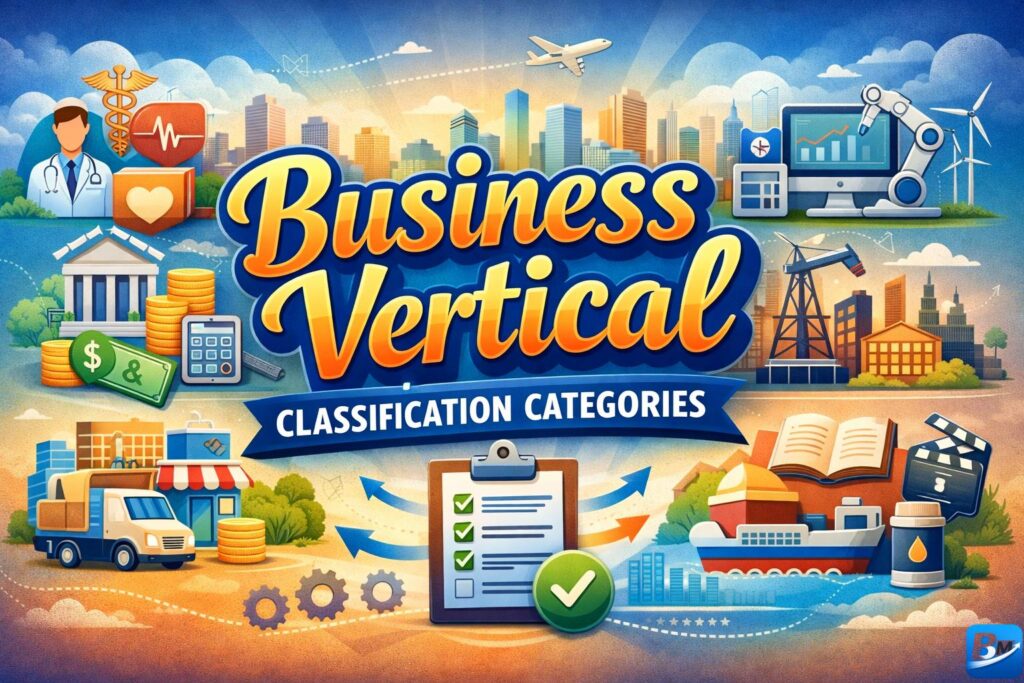


































Business Vertical Classification Categories

In today’s fast-paced business environment, organizations must have a clear understanding of the industries they operate in to stay competitive and make informed decisions. By identifying and analyzing different sectors, companies can focus their resources, align strategies, and target the right audiences more effectively. Structured classification allows businesses to see the bigger picture, compare performance with industry standards, and prioritize growth opportunities in the most relevant markets.
Business Vertical Classification Categories play a vital role in this process by providing a systematic way to organize industries into clearly defined groups. From healthcare and finance to technology and logistics, these categories help businesses streamline operations, improve marketing strategies, and enhance decision-making. Implementing a well-defined vertical classification system ensures that organizations can operate efficiently, respond to market trends, and achieve sustainable growth across multiple sectors.
What Are Business Vertical Classification Categories?
A business vertical refers to a specific industry or sector in which a company operates. Unlike horizontal markets, which cater to a broad range of industries, verticals focus on a particular niche. Classification categories are systematic labels used to group businesses based on the sector, product type, or customer base they serve.
For example, a software company that provides healthcare management solutions would belong to the “Healthcare Technology” vertical. Meanwhile, a logistics firm specializing in food delivery would fall under the “Logistics & Transportation” vertical. These categories allow businesses to segment their operations, tailor services to specific industries, and analyze performance within a defined context.
Importance of Classifying Businesses by Vertical
Classifying businesses into vertical categories is crucial for several reasons:
1. Targeted Marketing and Sales
Understanding the vertical in which a business operates allows marketers to create industry-specific campaigns. For instance, content marketing strategies for the education sector will differ vastly from those used in the energy sector. By defining verticals, companies can develop tailored messaging, identify pain points specific to the industry, and improve conversion rates.
2. Operational Efficiency
Vertical classification provides operational clarity by aligning processes, resources, and teams according to industry requirements. For example, customer support teams in a financial services company may need specialized knowledge about banking regulations, whereas a retail business would focus on inventory and supply chain management.
3. Data Analysis and Benchmarking
When businesses are classified into verticals, performance metrics become more meaningful. Companies can benchmark against industry standards, compare growth rates, and identify opportunities for improvement. Reporting by vertical also facilitates better decision-making for investments, resource allocation, and market expansion.
4. Compliance and Risk Management
Certain industries, such as healthcare, finance, and energy, are highly regulated. Classifying businesses by vertical ensures that operations align with industry-specific compliance standards, mitigating legal risks and ensuring operational integrity.
Standard Business Vertical Classification Systems
Globally, businesses often follow structured frameworks for classification. Two of the most widely recognized systems are the Global Industry Classification Standard (GICS) and the Industry Classification Benchmark (ICB).
Global Industry Classification Standard (GICS)
Developed by MSCI and S&P, GICS organizes companies into four levels: sectors, industry groups, industries, and sub-industries. The framework includes 11 sectors, such as Healthcare, Technology, Financials, and Consumer Discretionary, which are further divided into industry groups and sub-industries. This system allows for precise categorization of public companies and is commonly used in financial reporting, investment analysis, and market research.
Industry Classification Benchmark (ICB)
ICB is a detailed taxonomy used by major stock exchanges to categorize publicly listed companies. It divides companies into 11 industries, 20 supersectors, 45 sectors, and 173 subsectors. ICB is particularly useful for cross-market comparisons, enabling investors and analysts to evaluate companies within the same vertical, regardless of geography.
These classification standards serve as authoritative guides and can inform business decision-making even for privately held companies and startups seeking to define their vertical focus.
Common Business Vertical Categories
Below is a comprehensive list of commonly recognized business vertical categories used by organizations globally:
- Healthcare: Hospitals, clinics, medical equipment suppliers, healthcare technology solutions.
- Financial Services: Banks, investment firms, insurance companies, fintech startups.
- Retail & E-commerce: Brick-and-mortar stores, online marketplaces, specialty retailers.
- Technology & Software: SaaS companies, IT consulting, cloud services, cybersecurity firms.
- Manufacturing: Automotive, electronics, consumer goods, industrial equipment production.
- Real Estate & Construction: Property development, construction firms, real estate agencies.
- Education: Schools, colleges, online learning platforms, training centers.
- Media & Entertainment: Broadcasting companies, publishers, content creators, gaming studios.
- Logistics & Transportation: Freight companies, delivery services, supply chain management.
- Energy & Utilities: Renewable energy, oil & gas, water and electricity providers.
- Hospitality & Tourism: Hotels, travel agencies, event management, restaurants.
- Agriculture & Food Production: Farms, food processing, agricultural technology providers.
These categories are not exhaustive but provide a practical framework for businesses seeking to understand their market position and define strategies accordingly.
How to Determine the Right Vertical for Your Business
Identifying the correct vertical is not always straightforward. Here are key steps organizations can follow:
- Analyze Products and Services: Determine the primary use case and end-user of your products or services.
- Understand Your Customers: Identify the industries your customers belong to and segment them accordingly.
- Evaluate Market Needs: Look at industry challenges and assess where your solutions fit best.
- Review Competitors: Analyze how competitors categorize themselves to uncover gaps or opportunities.
- Consider Compliance Requirements: Some verticals, like healthcare or finance, may require adherence to regulatory standards.
By following these steps, businesses can ensure accurate vertical classification, which enhances strategy, marketing precision, and operational alignment.
Best Practices for Business Vertical Classification
Successful vertical classification requires careful planning and ongoing evaluation. Here are recommended best practices:
- Limit the Number of Categories: Avoid creating too many verticals; focus on the most relevant sectors for clarity.
- Consistency in Naming: Use standardized naming conventions to prevent confusion across teams and reporting systems.
- Align With CRM Systems: Ensure that your customer relationship management tools reflect vertical categories for streamlined communication and analysis.
- Periodic Review: Industries evolve, and businesses expand. Reassess verticals regularly to accommodate market changes and business growth.
- Leverage Analytics: Use performance metrics to validate vertical classifications and make data-driven adjustments.
Implementing these practices ensures that vertical classification remains relevant, actionable, and beneficial over time.
Real-World Applications of Vertical Classification
Marketing Strategy
Businesses use vertical classification to tailor campaigns and engage the right audience. For example, a B2B software company may develop specific content for healthcare IT managers, while creating separate messaging for retail operations managers. Vertical-specific marketing improves engagement, leads, and ROI.
Financial Planning
Investors and analysts frequently examine performance by vertical. By categorizing companies, they can evaluate profitability, growth rates, and risk profiles more accurately. Similarly, businesses can use vertical data for budget allocation and forecasting.
Product Development
Vertical classification helps product teams customize offerings according to industry needs. For instance, cybersecurity software for the financial sector might prioritize fraud detection and regulatory compliance features, whereas healthcare solutions focus on patient data security.
Strategic Partnerships
Understanding verticals can also facilitate partnerships and collaborations. Companies within the same vertical often benefit from joint ventures, industry events, and shared resources that target a common market segment.
Challenges in Business Vertical Classification
Despite the benefits, classifying businesses into verticals can present challenges:
- Overlap Between Verticals: Some businesses operate across multiple industries, making classification ambiguous.
- Dynamic Market Trends: Industries evolve rapidly, and a vertical that is relevant today may shift tomorrow.
- Granularity Issues: Determining how specific or broad a category should be requires judgment.
- Data Consistency: Ensuring all departments adopt the same classification system can be challenging, particularly in large organizations.
Addressing these challenges requires thoughtful planning, clear guidelines, and periodic evaluation of vertical categories.
Conclusion
Effective business vertical classification categories are the backbone of strategic decision-making, marketing efficiency, and operational clarity. By understanding the concept, implementing structured frameworks like GICS or ICB, and following best practices, businesses can gain actionable insights, streamline operations, and drive growth. Accurate classification also facilitates compliance, benchmarking, and industry-specific strategy execution.
For businesses seeking expert guidance in defining, refining, or implementing their vertical strategy, hiring Businesses Mag can provide tailored solutions that ensure precise classification, enhanced analytics, and market alignment. Whether for startups or established enterprises, mastering business verticals is essential for staying competitive and responsive in today’s dynamic market landscape.