




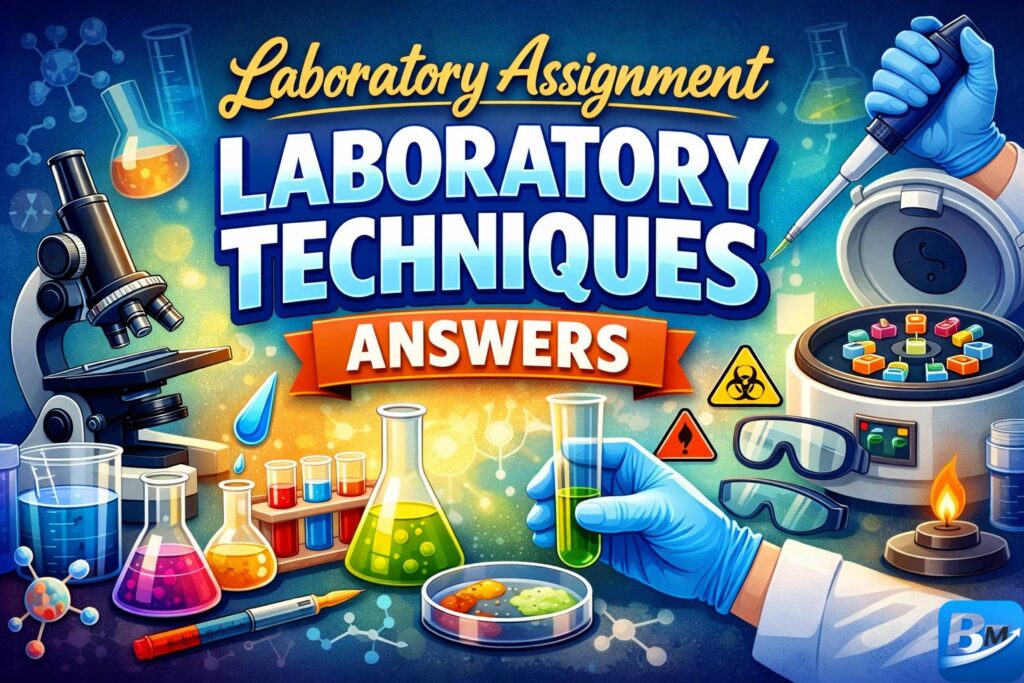












































































































































Laboratory Assignment Laboratory Techniques Answers

Laboratory assignments bridge the gap between theory and hands-on science practice. Many students struggle because these tasks require both an understanding of scientific concepts and mastery of laboratory techniques. Using Laboratory Assignment Laboratory Techniques Answers can provide structured guidance to perform experiments accurately, safely, and efficiently.
These assignments are designed to develop critical skills in observation, measurement, and procedural accuracy. Simply knowing theoretical concepts is not enough; students must handle laboratory equipment correctly, perform experiments properly, and follow safety protocols. Detailed step-by-step answers help students enhance both their practical and theoretical understanding of laboratory science.
Understanding Laboratory Techniques
Laboratory techniques are standardized methods used to carry out experiments safely and accurately. Assignments often test a student’s ability to perform these techniques under supervision or explain them through written responses. Key laboratory techniques include:
- Pipetting: Involves transferring specific volumes of liquid using a pipette. Precision is crucial because errors can lead to inaccurate experimental results. Assignments may require demonstrating proper pipette use or calculating the volume transferred.
- Titration: Used to determine the concentration of a solution. Students are tested on following procedural steps, reading the burette accurately, and calculating concentrations using formulas. Understanding the concept behind titration is more important than memorizing results.
- Filtration and Centrifugation: Separate mixtures based on physical properties. Filtration removes solids from liquids, while centrifugation spins samples to separate substances by density. Students may need to select the appropriate method for a given sample.
- Microscopy: Preparing slides and observing specimens under a microscope is a fundamental biology skill. Assignments may involve labeling slides, identifying cell structures, or adjusting the microscope for optimal viewing.
- Sample Preparation and Storage: Proper labeling, handling, and storage prevent contamination or degradation. Assignments may test knowledge of safe storage for biological, chemical, or environmental samples.
Mastering these techniques is essential for accurate assignments and developing practical skills for exams, research, or future scientific careers.
Common Laboratory Equipment and Their Uses
Understanding laboratory equipment is crucial for completing assignments effectively. Common equipment includes:
- Beakers and Flasks: For mixing, heating, and storing liquids. Choosing the correct container is often tested.
- Test Tubes: Ideal for small reactions or handling multiple samples. Proper handling prevents contamination.
- Pipettes and Micropipettes: Transfer accurate liquid volumes. Assignments may include calculating total volumes transferred.
- Burettes: Used in titration experiments for precise measurement. Correct reading of the meniscus is often tested.
- Centrifuge Machines: Separate substances by density. Understanding speed and timing is critical.
- Microscopes: Magnify and observe small structures. Assignments may involve slide preparation and identification of microscopic features.
Mastering equipment use helps students complete assignments efficiently while reinforcing essential laboratory skills.
Laboratory Safety: A Core Component
Safety is non-negotiable in laboratory assignments. Many assignments test students’ knowledge of safety protocols to protect themselves and others. Essential safety practices include:
- Wearing lab coats, gloves, and goggles to prevent chemical or biological exposure.
- Recognizing chemical hazard symbols and understanding their meanings.
- Handling equipment and chemicals carefully to avoid accidents, spills, or contamination.
- Knowing the location and proper use of emergency equipment such as fire extinguishers, eyewash stations, and first aid kits.
- Following proper disposal methods for chemical and biological waste.
Assignments may also include situational questions, such as responding to chemical spills, broken glass, or accidental contamination. Familiarity with safety protocols ensures better grades and safe laboratory practices.
How to Use Laboratory Assignment Laboratory Techniques Answers Effectively
Ready-made answers can help students, but using them strategically ensures genuine learning:
- Understand the steps, don’t memorize blindly: Focus on the reasoning behind each technique.
- Cross-check with manuals or textbooks: Ensure the accuracy of answers using reliable sources.
- Practice practical skills: Use answers as a guide to perform experiments hands-on.
- Take detailed notes: Document observations, calculations, and procedures for better retention.
- Analyze mistakes: Learn from common errors highlighted in answers to avoid repeating them.
By combining reference answers with hands-on practice, students develop a deeper understanding of laboratory techniques and improve problem-solving skills.
Additional Tips for Assignment Success
- Read each question carefully to determine if it tests theory, technique, or safety.
- Prepare diagrams or charts to illustrate procedures, equipment setup, or experiment results.
- Practice calculation-based questions, especially in titration, dilution, and solution preparation.
- Review previous lab reports to understand formatting, observations, and results presentation.
- Seek clarification from instructors if a technique or procedure is unclear.
These strategies enhance both assignment performance and overall scientific literacy.
Frequently Asked Questions (FAQs)
1. What are Laboratory Assignment Laboratory Techniques Answers?
They are reference guides providing explanations, step-by-step procedures, and insights to complete laboratory assignments accurately.
2. Are these answers suitable for learning purposes?
Yes, when used as a reference to understand procedures, not for direct copying. They help reinforce practical skills.
3. Which laboratory techniques are most commonly included in assignments?
Pipetting, titration, microscopy, filtration, centrifugation, and sample preparation are frequently tested.
4. How can students improve their lab assignment scores?
Practice techniques, understand equipment use, follow safety rules, and cross-check answers with reliable sources.
5. Can these answers help in practical exams?
Absolutely. They guide correct procedures, highlight common mistakes, and show proper handling of equipment, benefiting both assignments and exams.